AVAILABLE fall 2026
〰️
AVAILABLE fall 2026 〰️
PREVIEW OF PART ONE
• WHERE WE WERE •
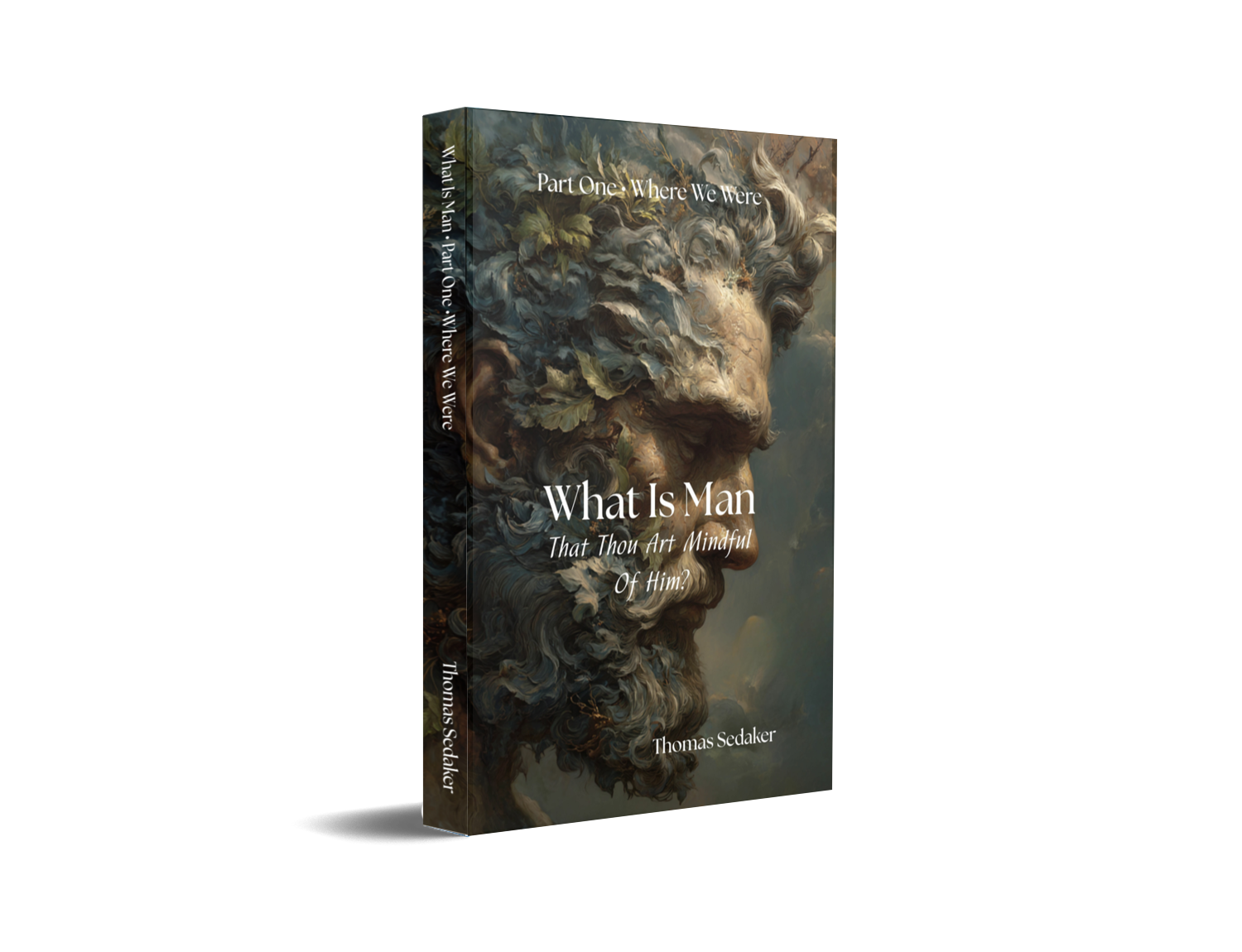
“Tom’s book calls us to walk mindfully with Christ, embrace the abundance He has provided, and allow both our hearts and minds to be transformed by His love. For me, this book reopened the garden, and for that I am deeply grateful.””
“So, who should read this book? I would think anyone seeking a deeper
understanding of God. That is why I am encouraging seekers, hungry hearts, the serious Bible student, Bible study groups, and those who simply want to understand God’s intention for His creation, to pick up this book and read it. If you choose to do so, all I can say is “get ready.” You are about to go on a “real” God adventure.”
“I felt the love of God coming through the pages. We ought to all be humbled at what’s being conveyed here.”
Introduction
“When I consider Your heavens, the work of Your fingers, The moon and the stars, which You have ordained; What is man that You are mindful of him, And the son of man that You visit him?” Psalm 8:3–4 NKJV
Do you enjoy looking up at the night sky and embracing the wonderment of God’s heavenly creation? If so, you are probably already aware that depending on the time of year (winter or summer), how close you live to a big city (light pollution), weather conditions (clear or overcast), a new or full moon, smog, or even living in the northern or southern hemisphere can all play a part in whether you see a star-studded sky or practically none.
With this in mind, I would like to share a personal stargazing experience, one that so profoundly shook my world, I am still enraptured by the memory. It happened innocently enough when years ago, I left San Diego one early Monday morning with hopes of arriving in Cabo San Lucas by the weekend. On my second full day of driving down the Baja in my ’64 Chevy pickup, I finally made my way to a small fishing village called Mulegé, just south of Santa Rosalia on the eastern coast of the peninsula.
Arriving long after sunset, I quickly found that not only did this sleepy little community lack the streetlights we all take for granted, it gave new meaning to the phrase “dark-night.” Even my truck’s headlights could not ignite the evening with more than a glimpse of the road, let alone, hint at how close I was to the Sea of Cortez looming in the distance. Truth be known, it was unnerving to be in such a remote area and not have enough light to see my surroundings. That would have to wait till morning.
Thankfully, I soon found what looked like a suitable place to camp, and after hopping out to stretch my legs, my attention was immediately drawn to how still the night had become. With only the sound of water gently lapping against the shoreline, I could not help but think how distant this place seemed in relation to the rest of the world; there was absolutely no one around to disturb its pristine aura but me. Have you ever had such an experience?
That is when I happened to look heavenward, more curious as to why the evening seemed so dark than having a desire to stargaze. What I saw next took my breath away. There, directly above my head on that moonless night shone a cluster of stars so thick, it appeared like a solid white sheet of glimmering sparkles; a mass of such brilliance, I literally staggered backward at the sudden surprise of such a landscape of stars. Honestly, in all my years of living, I had never witnessed a night sky so imposing—so majestic.
Star-struck in every sense of what that means, I could hardly catch my breath before a sudden rush of emotions welled up inside me erupting in a gush of tears. Overwhelmed and no longer able to bear the weight of my inadequacies, I soon collapsed to the ground, consumed with thoughts of how insignificant and inconsequential my life appeared in comparison to this grand display.
And at that moment, I had confidence in only one thing. Whoever God was, for Him to have created such a magnificent universe, it was all too glorious and far beyond my grasp. To this day, I have yet to recover ... thank goodness!
Can you relate? Certainly, a similar notion must have been what swirled around King David’s mind when he looked up into his nighttime sky and asked God, “Why are you so mindful?” With astronomers estimating over 2 trillion galaxies in the known universe (Hubble study), each having millions and billions of stars along with an innumerable number of planets (the Milky Way alone has an estimated two to four hundred billion stars), as with David’s pondering, it is almost inconceivable to think that God had a Master Plan with us in mind. Yet, at some point in eternity past, God declared “the end from the beginning” (Isa. 46:10) and then set out to implement His plan; one that not only included the redemption of mankind, but the gathering of everything He has made in the visible and invisible realms and placing it all under the headship of Christ. What is Man that Art Mindful of Him? is about defining God’s plan and identifying man’s purpose in it all.
In regard to how this book came to fruition, this was not a planned event. Through a series of visions and various encounters with the Holy Spirit, I was compelled to put pen to paper, God making His intentions clear by instructing me to write about His mindfulness and purposes for man from three perspectives of time:
Where We Were
Where We Are
Where We Are Going
Sound far-fetched? While I am aware there are some who would insist that God does not interact with His church the way He did during the times of the first apostles, my experience says otherwise. Always worshipful and seeking God’s face, His presence is often so thick upon me, I can slice it with a knife and butter both sides!
I have also felt the cool winds of God’s presence blow upon my face, stood in the midst of the Glory Cloud, had experiences in Him that defy explanation, and I have continued to have visions and dreams, some of which are quite profound. I have even had the privilege of the Lord standing in front of me and speaking—all with only the aid of God’s indwelling Holy Spirit taking from the Lord Himself and infusing me with His essence (read John 16:13). The book you now hold (Part One—Where We Were) is the direct result of such intimacies with our Savior, Jesus. Within, we are going to explore what happened to Adam and Eve in the garden and how their lives and ours have been affected by their failings.
As for the three time elements, although I was initially curious as to why the Lord would have me write about man within the contextual framework of TIME-past, TIME-present, and TIME-future, I have come to see that without an accurate accounting of our present moment (Where We Are), charting a course into our future (Where We Are Going) becomes an almost impossible task. At best, our hope rests in us being “educated” guessers with fingers crossed!
This is also where the tricky part comes into play. To accurately appraise our “present moment,” we need to tell the truth about how we arrived at our current set of circumstances, an impossible determination to make without an honest assessment of Where We Were. Until then, we not only lack the means to properly evaluate our “present moment,” we are incapable of fully appreciating God’s love in our “here and now.” This is a subject we will be talking about in great detail throughout the book.
We will also be examining what Paul meant when he observed that God had an “eternal purpose” (Eph. 3:11), an overall Master Plan that goes far beyond the scope of man’s salvation. Of course, we will investigate this line of thought through the eyes of what He had in mind for mankind—intentions “promised before the world began” (Titus 1:2). Once the pieces of this “bigger picture” are put in their proper places, the equally big questions of who we are, what we are, where we are going, and why God’s attention is centered on us (when there seems to be so much more He could be concerned about), will become clear as well.
With reference to Scripture and format, I have chosen the King James Version as the default when quoting from the Bible. However, in cases where I felt another translation brought greater clarity, it has been referenced accordingly. I have also emboldened each Scripture used to make my points. Each subsequent use of the same rendering is either in quotations and not emboldened, or along with other points I am making, italicized or capitalized when I want to emphasize a point. Regardless, in all instances, I encourage the reader to check each use of God’s Word and make a self-determination as to whether Scripture has been used in its correct context or not.
I have also added personal thoughts and commentary throughout the book where I felt it appropriate, choosing to feature and embolden my quotes with a final author’s caption, “Gospel according to Tom.” I have done so to highlight that my thoughts are uniquely my own and should NOT be confused with or equated to the weight of the four Gospels offered in the New Testament.
Lastly, I have italicized two pairings of words throughout the book: kindness and severity (the two ways God has chosen to express His love toward all of His creatures), and natural and spiritual. My intent with this latter pairing is only to draw attention to their differences in regard to our human condition. Hopefully, at the conclusion of Part One, you will have a new appreciation for the distinctions between this pairing in particular.
One final thought. Although the Bible starts out with a narrative of Adam and Eve’s creation and their subsequent fall, this is not where God’s story begins, a presumption I believe most have arrived at due to the preoccupation we have with our own importance ... and who could blame us? Once you get past man’s holy trinity of “me, myself, and I,” what else could there possibly be to consider?
This is why I feel compelled to emphasize that there is a much bigger picture to what happened with Adam and Eve than has been taught traditionally. When brought into proper focus, we are going to find that while man was most certainly the focal point of what God was doing on this earth, he was by no means the only thing God was concerned about.
To see this, however, we will need to identify where God’s story begins. Then, in much the same manner as a detective might go about trying to solve a mystery, we will glean the evidence for clues leading to a greater understanding of what Paul said was God’s “eternal purpose which he purposed in Christ Jesus our Lord” (Eph. 3:11).
Ready? Let’s begin.